Riddles are not just puzzles to solve; they’re a fun way to challenge the mind and see things from a new perspective. One of the most popular riddles out there is the tricky “30 cows and 28 chickens” riddle, a perfect example of how a simple phrase can hide a clever twist. This riddle, along with others, helps us think laterally, turning everyday concepts into intriguing puzzles.
If you’re ready to test your mental agility, read on! Below, you’ll find 33 engaging and creative riddles, with a focus on the famous “30 cows and 28 chickens” riddle, all designed to spark your curiosity and challenge your brain. Let’s dive in!
33 Creative Riddles Related to the “30 Cows and 28 Chickens” Riddle
1. Riddle:
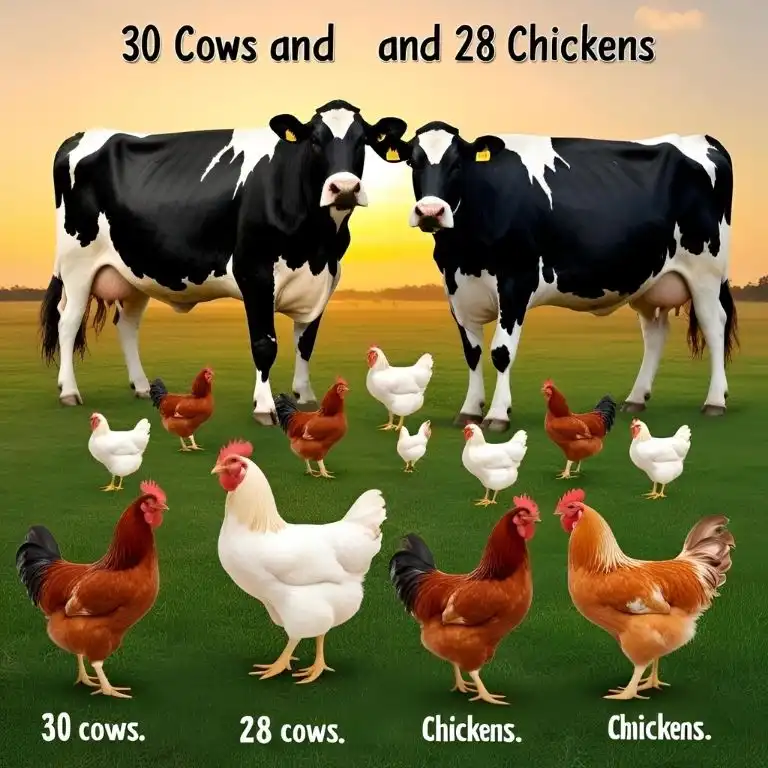
There are 30 cows in a field, and 28 chickens. How many didn’t?
Answer and Explanation:
- Answer: 2
- Explanation: The riddle plays on the word “28” as “twenty ate.” The question is asking how many cows didn’t eat chickens. Since 28 chickens were eaten, only 2 cows didn’t eat chickens.
2. Riddle:
What comes once in a minute, twice in a moment, but never in a thousand years?
Answer and Explanation:
- Answer: The letter “M”
- Explanation: The letter “M” appears once in “minute,” twice in “moment,” but it doesn’t appear at all in “a thousand years.”
3. Riddle:
What has a head, a tail, but no body?
Answer and Explanation:
- Answer: A coin
- Explanation: A coin has a “head” and a “tail” (the two sides of the coin), but no physical body.
4. Riddle:
What can travel around the world while staying in the corner?
Answer and Explanation:
- Answer: A stamp
- Explanation: A stamp is placed in the corner of an envelope, and when the envelope is mailed, it can travel around the world.
5. Riddle:
What has keys but can’t open locks?
Answer and Explanation:
- Answer: A piano
- Explanation: A piano has keys, but they are for playing music, not for unlocking doors.
6. Riddle:
What has many books but doesn’t read?
Answer and Explanation:
- Answer: A library
- Explanation: A library contains many books, but it doesn’t “read” them. It’s a place for books to be stored and accessed.
7. Riddle:
I am something you can never touch, but I’m always in your classroom. What am I?
Answer and Explanation:
- Answer: A lesson
- Explanation: Lessons are intangible—they can’t be physically touched, but they are always present in a classroom setting.
8. Riddle:
What gets wetter as it dries?
Answer and Explanation:
- Answer: A towel
- Explanation: A towel becomes wetter as it dries something else, like a person or object.
9. Riddle:
I am full of holes, but I can still hold water. What am I?
Answer and Explanation:
- Answer: A sponge
- Explanation: A sponge is porous and full of holes, but it holds water because of its structure.
10. Riddle:
I am something you can always find at school, but you can’t hold in your hands. What am I?
Answer and Explanation:
- Answer: Knowledge
- Explanation: Knowledge is something that is always in the classroom, but it’s intangible and cannot be physically held.
11. Riddle:
I have a face, but no eyes, mouth, or nose. What am I?
Answer and Explanation:
- Answer: A clock
- Explanation: A clock has a “face” (the part with the numbers and hands), but no actual facial features like eyes or a mouth.
12. Riddle:
I start with an “E,” end with an “E,” and contain only one letter. What am I?
Answer and Explanation:
- Answer: An envelope
- Explanation: An envelope starts and ends with the letter “E,” and it often contains just one letter (as in a piece of mail).
13. Riddle:
What starts with an “S,” ends with an “E,” and has a million letters inside?
Answer and Explanation:
- Answer: A post office
- Explanation: A post office starts and ends with “S” and “E,” and it handles millions of letters (pieces of mail).
14. Riddle:
What can be broken but never held?
Answer and Explanation:
- Answer: A promise
- Explanation: A promise can be broken, but it is an abstract concept that cannot be physically held.
15. Riddle:
I can be long or short, I can be grown or bought, I can be painted or left bare. What am I?
Answer and Explanation:
- Answer: A pencil
- Explanation: A pencil can be of different lengths, purchased, and can be either painted or plain.
16. Riddle:
I have cities, but no houses. I have forests, but no trees. I have rivers, but no water. What am I?
Answer and Explanation:
- Answer: A map
- Explanation: A map contains representations of cities, forests, and rivers, but they are not real—they are just illustrations.
17. Riddle:
What goes up but never comes down?
Answer and Explanation:
- Answer: Your age
- Explanation: As time passes, your age increases, but it never decreases.
18. Riddle:
What has a head and a tail, but no body?
Answer and Explanation:
- Answer: A coin
- Explanation: A coin has a “head” (one side) and a “tail” (the other side), but no actual body.
19. Riddle:
What has to be broken before you use it?
Answer and Explanation:
- Answer: An egg
- Explanation: Before using an egg in cooking, you have to crack it open, making it something that must be “broken” first.
20. Riddle:
I can be cracked, made, told, and played. What am I?
Answer and Explanation:
- Answer: A joke
- Explanation: A joke can be cracked, made, told, and played on others for fun.
21. Riddle:
What has many pages but doesn’t read?
Answer and Explanation:
- Answer: A calendar
- Explanation: A calendar has many pages (one for each day or month), but it doesn’t “read” anything. It’s for organizing time.
22. Riddle:
What is a room without walls or a ceiling?
Answer and Explanation:
- Answer: A classroom
- Explanation: The concept of a classroom without walls or a ceiling is a metaphor for the mind’s potential to learn anywhere.
23. Riddle:
What runs but never walks?
Answer and Explanation:
- Answer: A river
- Explanation: A river runs along its course, but it never walks.
24. Riddle:
What has teeth but doesn’t bite?
Answer and Explanation:
- Answer: A comb
- Explanation: A comb has teeth, but they don’t bite anything.
25. Riddle:
What comes down but never goes up?
Answer and Explanation:
- Answer: Rain
- Explanation: Rain falls from the sky but never rises back up to the clouds by itself.
26. Riddle:
What gets smaller the more you use it?
Answer and Explanation:
- Answer: A pencil
- Explanation: The more a pencil is used for writing, the shorter it becomes.
27. Riddle:
What is always ahead of you but never seen?
Answer and Explanation:
- Answer: The future
- Explanation: The future is always ahead of you in time, but it can never be physically seen.
28. Riddle:
What has an eye but can’t see?
Answer and Explanation:
- Answer: A needle
- Explanation: A needle has an “eye” (the hole through which thread passes), but it cannot see.
29. Riddle:
What can be heard but not seen?
Answer and Explanation:
- Answer: Sound
- Explanation: Sound can be heard, but it is invisible to the naked eye.
30. Riddle:
What’s full of holes but still holds a lot?
Answer and Explanation:
- Answer: A net
- Explanation: A net is full of holes but can still hold things, like fish or other objects.
31. Riddle:
What has a neck but no head?
Answer and Explanation:
- Answer: A bottle
- Explanation: A bottle has a neck (the narrow part at the top) but no head.
32. Riddle:
What can you catch but never throw?
Answer and Explanation:
- Answer: A cold
- Explanation: You can catch a cold, but you can’t physically throw it.
33. Riddle:
What’s a question but has no answer?
Answer and Explanation:
- Answer: A riddle
- Explanation: A riddle is often a question that has a clever answer, but without solving it, the answer remains unknown.
Conclusion
Riddles are a delightful way to exercise the brain while having fun. The famous “30 cows and 28 chickens” riddle is just one example of how a clever twist can make even the most ordinary situations intriguing. By challenging our minds to think differently, riddles help us sharpen our problem-solving skills and encourage creative thinking.
Feel free to share your thoughts, favorite riddles, or other mind-bending puzzles in the comments! We’d love to hear what you think and continue the fun with more riddles.
More Riddles Articles