Riddles can be a fun, playful, and mysterious way to spark curiosity and challenge your mind. Whether you’re solving them on your own or with friends, each riddle offers entertaining insights and a twist of lateral thinking that keeps you on your toes.
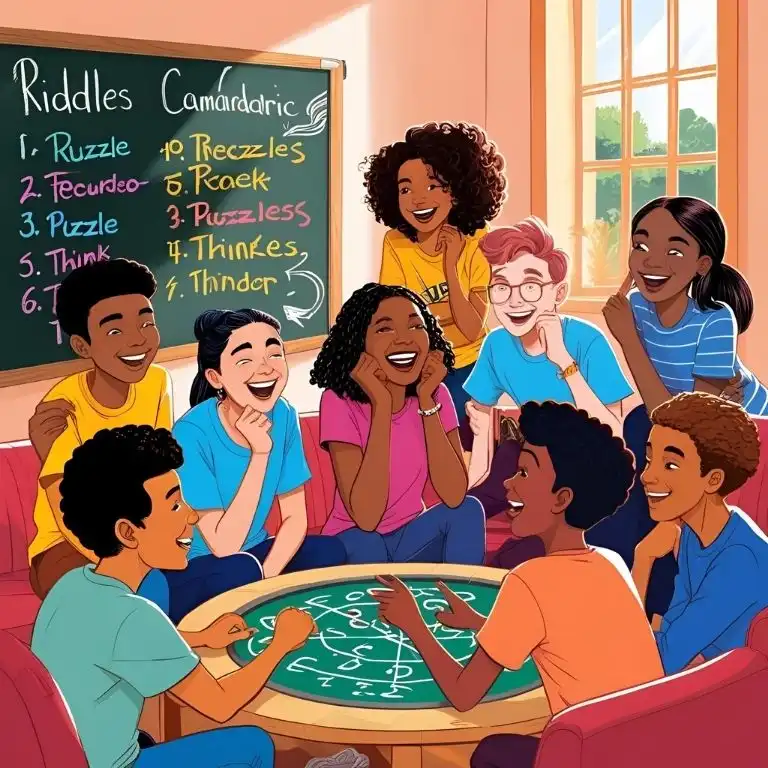
Riddles for Teens with Answers
- Riddle: “I speak without a mouth and hear without ears. What am I?”
Answer: An echo.
Explanation: It plays on the idea of sound repeating without a physical voice.
- Riddle: “I come once in a minute, twice in a moment, but never in a thousand years. What am I?”
Answer: The letter M.
Explanation: It tricks you by using the structure of words rather than time.
- Riddle: “What has keys but can’t open locks?”
Answer: A piano.
Explanation: It uses the double meaning of “keys” to create a playful challenge.
- Riddle: “What has a head and a tail but no body?”
Answer: A coin.
Explanation: The riddle cleverly uses parts of a coin to mislead you.
- Riddle: “What gets wetter as it dries?”
Answer: A towel.
Explanation: It presents a paradox that plays on the process of drying.
- Riddle: “What can travel around the world while staying in a corner?”
Answer: A stamp.
Explanation: It twists your perspective by connecting travel with postage.
- Riddle: “What has many teeth but cannot bite?”
Answer: A comb.
Explanation: It uses the literal term “teeth” in an unexpected way.
- Riddle: “What has hands but can’t clap?”
Answer: A clock.
Explanation: The riddle exploits the double meaning of “hands” in a playful manner.
- Riddle: “I have branches but no fruit, trunk, or leaves. What am I?”
Answer: A bank.
Explanation: It challenges your assumptions by using a metaphor for organizational structure.
- Riddle: “What runs but never walks?”
Answer: A river.
Explanation: It redefines “running” in a natural context.
- Riddle: “What has a heart that doesn’t beat?”
Answer: An artichoke.
Explanation: It plays on the term “heart” as both a core and an emotion-less part of a plant.
- Riddle: “What can you catch but not throw?”
Answer: A cold.
Explanation: It uses the dual meaning of “catch” in a clever twist.
- Riddle: “What has words but never speaks?”
Answer: A book.
Explanation: It reimagines how words can exist without being verbally expressed.
- Riddle: “What is so fragile that saying its name breaks it?”
Answer: Silence.
Explanation: The riddle uses the paradox of sound to challenge your thinking.
- Riddle: “What begins with T, ends with T, and has T in it?”
Answer: A teapot.
Explanation: It’s a pun that plays on the pronunciation of the letter T.
- Riddle: “What goes up but never comes down?”
Answer: Your age.
Explanation: It flips the concept of movement by using a natural, unidirectional process.
- Riddle: “What has one eye but cannot see?”
Answer: A needle.
Explanation: It employs literal imagery to create a surprising answer.
- Riddle: “What building has the most stories?”
Answer: A library.
Explanation: It cleverly plays on the double meaning of “stories.”
- Riddle: “What kind of room has no doors or windows?”
Answer: A mushroom.
Explanation: It uses wordplay to connect an everyday object with a pun.
- Riddle: “What is always in front of you but can’t be seen?”
Answer: The future.
Explanation: It teases the abstract concept of time with a hint of mystery.
- Riddle: “What can fill a room but takes up no space?”
Answer: Light.
Explanation: It challenges your physical perceptions with a simple truth.
- Riddle: “What has an eye but cannot see and is found in the ocean?”
Answer: A storm.
Explanation: It draws on the common phrase “the eye of the storm” for its twist.
- Riddle: “What invention lets you look right through a wall?”
Answer: A window.
Explanation: It uses a straightforward object in a deceptively clever way.
- Riddle: “What can run but never walk, has a mouth but never talks?”
Answer: A river.
Explanation: It reinforces the idea of natural phenomena through repetition.
- Riddle: “What is full of holes but still holds water?”
Answer: A sponge.
Explanation: It turns a common object into a riddle by challenging expectations.
- Riddle: “What has a bed but never sleeps?”
Answer: A river.
Explanation: It plays on the dual meaning of “bed” to create a clever twist.
- Riddle: “What gets bigger the more you take away?”
Answer: A hole.
Explanation: It cleverly contradicts the usual idea of subtraction.
- Riddle: “What goes up and down but doesn’t move?”
Answer: Stairs.
Explanation: It challenges your perception of movement through clever wordplay.
- Riddle: “What kind of coat is best put on wet?”
Answer: A coat of paint.
Explanation: It uses the pun between a literal coat and a figurative layer.
- Riddle: “What has ears but cannot hear?”
Answer: Corn.
Explanation: It leverages the double meaning of “ears” in a playful manner.
- Riddle: “What do you call a boomerang that won’t come back?”
Answer: A stick.
Explanation: It takes a common object and gives it an unexpected twist.
- Riddle: “What can you keep after giving it to someone?”
Answer: Your word.
Explanation: It uses a familiar idiom in a clever, reflective way.
- Riddle: “What has a ring but no finger?”
Answer: A telephone.
Explanation: It plays with the dual meaning of “ring” to create a fun twist.
Conclusion
In this collection of 33 creative riddles for teens with answers, we explored playful challenges that spark curiosity and inspire lateral thinking. Each riddle offers a unique twist that combines simple language with clever wordplay.
We invite you to reflect on these puzzles and share your own experiences, favorite riddles, or thoughts in the comments below.
Let’s keep the conversation going—what riddles do you enjoy the most?